Tag Archive for: corporate giving

Building relationships with corporate partners remains one of the most effective ways to scale your organization’s impact and reach new audiences. However, getting started can feel overwhelming, especially when you’re already juggling all of the daily operations of running a nonprofit. But pursuing corporate volunteerism is worthwhile because not only does it help you build relationships with corporate partners, but it can also help you gain the bandwidth your organization needs to manage its various activities effectively.

To help you navigate these opportunities, this guide will explain a few popular types of corporate volunteer programs. We’ll also offer actionable tips on leveraging these programs to secure sustainable, long-term support.

The Basics of Corporate Volunteerism

Corporate volunteerism is a strategic alliance between nonprofits and businesses in which businesses encourage their employees to dedicate their time and expertise to organizations committed to social causes.

Both nonprofits and businesses benefit from this type of arrangement. Companies can boost their reputations as socially responsible businesses and significantly increase their employee engagement. At the same time, nonprofits acquire essential volunteer assistance and form community partnerships that frequently lead to other mutual benefits in the future. In fact, according to Double the Donation’s Nonprofit Corporate Engagement Report, about three-fourths of nonprofits believe that workplace volunteering is crucial to their strategies.

Successfully pitching these programs to potential partners requires framing your nonprofit’s needs as direct solutions to a company’s internal goals. When you demonstrate how volunteering with your organization can improve businesses’ team building and employee retention metrics, corporate leaders become eager to participate.

Popular Types of Corporate Volunteering Programs

Direct Service Volunteering

Direct service volunteering allows corporate groups to interact face-to-face with your mission and, often, your beneficiaries. This type of volunteering program involves hands-on work, such as serving meals, caring for shelter pets, or cleaning up local parks.

To ensure a direct service volunteering program is a success, you should have well-structured, easily explainable tasks ready to go before a group arrives. This preparation lets teams start making an impact right away and maximizes their time with your organization.

Indirect Service Volunteering

Indirect service volunteering generally doesn’t involve any face-to-face interactions with beneficiaries. Instead, volunteers provide behind-the-scenes support—they can assemble care packages, organize inventory, or sort donations in your facility.

Make sure to implement clear guidelines and quality control measures so volunteer outputs are as useful as possible to your organization. You can train your volunteers for these tasks when they arrive or provide tutorial videos to watch in advance. For more in-depth roles, online courses and other resources are ideal.

Volunteer Grants

Also known as Dollars for Doers, a volunteer grant program involves companies making a financial donation to an eligible nonprofit after an employee volunteers for a specified number of hours. Because of this unique stipulation, accurately tracking volunteer hours is crucial to securing these grants.

A surprising number of professionals don’t know that their employers offer volunteer grants. Therefore, you should proactively remind your supporters to check their employers’ grant policies to multiply their overall impact—for instance, by sending out letters directly after events or near the end of each calendar year. That way, you can remind your volunteers that they may be eligible for a grant while the experience is still fresh in their minds.

Skill-Based Volunteering

Skill-based volunteering (SBV) allows employees to use their skills in furthering your nonprofit’s mission. Common examples include a lawyer offering pro bono legal services to help an organization negotiate a contract, an accountant helping nonprofits file tax forms at no cost, and graphic designers making marketing materials for an upcoming fundraising event.

To recruit the right support for your nonprofit, you need to understand what type of assistance your team needs. Be sure to clearly define what roles you need on your website’s volunteer page. In addition to role-specific and general requirements, you may also include your overall philosophy and address a few frequently asked questions.

Volunteer Time Off

Volunteer time off (VTO) allows employees to volunteer during standard work hours as a subset of their paid time off. Companies that have VTO policies usually offer their staff between 8 and 40 hours every year, and all types of volunteering (including direct, indirect, and skills-based) are applicable.

This type of corporate volunteering program encourages coordinators to define roles specifically suited to VTO participants. These individuals perfectly fill critical midday operational gaps that your traditional weekend volunteers can’t cover. For example, if you’re running an animal shelter, you would need someone to provide basic care for your rescue pets multiple times per day, including in the mornings when staff are busy with admin work. In this situation, you can promote morning volunteer shifts to your VTO-eligible volunteers.

Like with volunteer grants, consider sending volunteer time-off letters to your volunteer base that explain how to check their eligibility and highlight the specific roles you’re looking to fill in these letters.

Corporate Volunteerism Tips for Nonprofits

Attracting and retaining corporate partners requires a proactive, professional approach to relationship management. Here are a few strategies you can try:

  • Build long-term partnerships with companies. Clearly communicate your mission from the first interaction with a potential partner and consistently highlight the mutual benefits of the partnership. You can also keep them engaged by sending them recurring impact reports and providing tailored sponsorship perks. When companies feel like true partners, they are more likely to renew their commitments and increase their contributions over time.
  • Share educational content about corporate volunteerism. As mentioned previously, many employees aren’t aware of their employers’ corporate volunteering programs. You can remedy this issue by distributing informative content about corporate volunteerism to your supporters to encourage them to advocate for your nonprofit within their own workplaces.
  • Invest in comprehensive volunteer management software. Adopting dedicated volunteer management software streamlines the process of scheduling, tracking, and communicating with corporate volunteers. When shopping for this type of software, Better Impact recommends choosing a provider with a robust database, a customizable recruitment form builder, user-friendly hours tracking features, and built-in email and SMS communication tools.

Above all, make sure to cultivate corporate relationships year-round and treat volunteer programs as integrated partnerships. Doing so will provide your nonprofit with reliable service from dedicated supporters who are deeply invested in your long-term success.

Wrapping Up

Navigating corporate volunteering requires intentional preparation, a variety of engagement options, and the ability to clearly demonstrate impact to partners. By building structured, mutually beneficial relationships, your organization can reliably expand your workforce and community footprint.

 

A picture of Timothy Sarazen

By Tim Sarazen, President of Better Impact

Timothy Sarazen is the President and CPO of Better Impact, a global software company dedicated to enhancing the experiences of nonprofits and volunteer-driven organizations in the healthcare and government sectors. With more than 13 years of experience working with product-led software solutions, Timothy believes strongly in turning complex challenges into simple, effective solutions that make customers’ lives easier through the smart use of technology. Based in Winston Salem, North Carolina, with his wife and three children, Timothy leads his team to empower organizations to align their efforts, improve decision-making, and showcase the measurable value of volunteer contributions.

The biggest obstacle standing between nonprofits and increased revenue is rarely donor unwillingness. Instead, it is often a simple lack of awareness regarding matching gift eligibility. If your supporters do not know these programs exist, they cannot participate, leaving significant funding unclaimed.

In this guide, we will outline an omnichannel marketing approach designed to close this gap. From optimizing your website to launching targeted email campaigns, we will demonstrate how to leverage fundraising software and donor stewardship to turn passive donors into active workplace giving participants.

1. How can my nonprofit promote matching gifts to donors?

You can promote matching gifts through an omnichannel marketing strategy. This involves the following:

  • Email outreach is a vital component of online fundraising, with multiple ways to engage supporters. Your nonprofit can send digital newsletters, thank-you emails, and dedicated match emails or follow-ups. These follow-up emails can include information targeted for each donor, providing company-specific details regarding the next steps and submission forms. This can help nudge eligible donors to submit matching gift requests to their employer and double their donation’s impact.
  • Your nonprofit’s website is the centralized hub for all information regarding your cause and how to get involved. Create a dedicated matching gift page to give donors a centralized resource to learn about matching gifts. Incorporate matching gift statistics or annual matching gift figures. Embed a matching gift database to make it easier for donors to check their eligibility.
  • Social media platforms are powerful tools for fundraising pushes and engagement opportunities⁠. Incorporate eye-catching graphics with short and sweet captions, hashtags, and more. Then, link to the dedicated matching gift page on your site from these posts so donors can learn more.
  • Market matching gifts directly within your donation process. Contextualize your request for employer data as a means of determining match eligibility status. Then, highlight matching gift eligibility on your donation confirmation screen. Using a matching gift tool to provide automated insights based on the employer a donor selected on the previous page streamlines this process. With a dedicated tool, you can give donors access to company specific insights, like minimum and maximum donation amounts, match ratios, qualifying nonprofits, employee types, and direct links to online submission forms.

2. Where should nonprofits place matching gift information on their website?

Key placements include donation forms, pop-ups, thank-you screens, dedicated matching gift pages, and your donation process. Embedding a fundraising search tool like Double the Donation can help you improve the visibility of matching gift information. By integrating effective automation software and providing step-by-step instructions, you can encourage donor submissions and maximize workplace giving revenue.

3. How can my nonprofit use email campaigns to boost matching gift submissions?

To boost matching gift submissions, your nonprofit can:

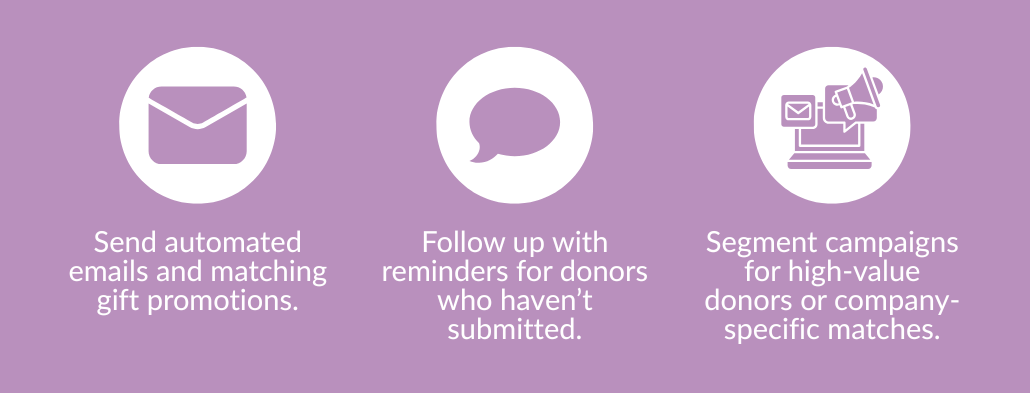
  • Send automated emails and matching gift promotions to donors immediately after they make their donation. Ensure that your outreach includes instructions and a link to search for eligibility via a fundraising tool like Double the Donation.
  • Follow up with reminders for donors who haven’t submitted.
  • Segment campaigns for high-value donors or company-specific matches.

This allows you to re-engage supporters while their donation is fresh and giving momentum remains high.


How your nonprofit can use email campaigns to boost matching gift submissions

How your nonprofit can use email campaigns to boost matching gift submissions


4. How can my nonprofit combine matching gifts with volunteer programs?

The most effective way to combine these programs is to treat a donor’s employment information as a “multi-purpose key.” Many corporations bundle their corporate social responsibility (CSR) initiatives, meaning a company that offers matching gifts is highly likely to also offer corporate volunteer grants or paid volunteer time off (PVTO).

Therefore, the strategy begins with data collection. When a supporter provides their employer’s name (whether during a donation checkout or a volunteer registration) you should not limit your screening to just one type of opportunity. Instead, you should ensure that you check for every available program that the company offers.

Here is how to turn that data into a cohesive strategy:

  • Comprehensive screening: When you capture a company name (e.g., “Microsoft”), use your fundraising software to query the database for all workplace giving programs. You will often find that the same company offering a 1:1 donation match also offers a monetary grant (e.g., $25 per hour) for time spent volunteering.
  • Cross-pollinated outreach: Once you know a supporter works for a company with a volunteer grant program, you can target your subsequent outreach specifically to them. instead of sending a generic “Come Volunteer” email, you can send a targeted message: “Did you know [Company Name] will donate to us if you volunteer 10 hours this month?”
  • Unified promotion: Specialized fundraising tools, like Double the Donation, allow you to promote these opportunities simultaneously. After a donor makes a gift, the automated follow-up can highlight their matching gift eligibility and inform them about available volunteer grants, effectively doubling the potential engagement points from a single interaction.

By validating all available programs upfront, you ensure that you are maximizing the revenue potential of every corporate partnership in your database.

5. How can my nonprofit use storytelling to increase matching gift submissions?

Effective storytelling bridges the gap between a corporate policy and a human impact. To drive submissions, you must move beyond the technical definition of a match and illustrate the tangible outcome of that extra revenue.

Here are three storytelling strategies to increase participation:

  • Visualize the multiplier effect: Start by highlighting the difference a match makes in program impact and share examples. Instead of saying “Your gift will be matched,” say “Your $50 provides one semester of supplies. With a match, that same contribution supports two students for the entire term.”
  • Leverage social proof: Feature testimonials from supporters who have successfully submitted a match. A short quote or video from a peer saying, “It only took me five minutes to log into my portal and double my donation,” is often more convincing than a set of instructions from your staff.
  • Celebrate the hidden heroes: In your newsletters and impact reports, explicitly recognize “corporate matched donors” as a distinct category of supporter. By publicly celebrating these individuals, you create a social incentive for others to check their eligibility and join that group.

6. How can staff and volunteers support matching gift programs?

Your staff can mention matching gift programs during donor calls, events, or volunteer orientation:

  • In regular communications such as email newsletters, internal meetings and social media channels, consistently remind staff and volunteers about available programs.
  • On your website, create a dedicated matching gift page with easy-to-follow, step-by-step guides on how to submit a matching gift request through their employer’s platform. Provide links to corporate portals or databases that list eligible companies and their specific guidelines.

Training your nonprofit team on effective fundraising tools can help your team guide supporters effectively and ensure consistent messaging across outreach.

7. How can nonprofits measure the success of matching gift campaigns?

To measure the success of your matching gift campaigns, your nonprofit should:

  • Track conversion rates, submission numbers, and total matched revenue
  • Monitor company-specific trends and monthly remittance reports to identify new match-eligible donors
  • Check email engagement rates to help refine communication strategies
  • Compare year-over-year match capture rates to refine strategies

By integrating a fundraising tool like Double the Donation, you can get access to these insights and analytics to inform outreach timing, messaging, and targeting.

Promoting Matching Gifts to Increase Donor Participation

Effective promotion of a matching gift program requires consistency across every touchpoint in the donor journey. By weaving these opportunities into your storytelling and digital presence, you not only secure immediate funds but also open the door to broader corporate volunteering and payroll giving conversations.

We encourage you to audit your automated donation receipts this week. Ensure they contain a clear call to action for matching gifts, as this single adjustment is often the highest-leverage step toward increasing your fundraising results.

To learn more about promoting matching gifts and other forms of workplace giving, explore more resources from Double the Donation and implement best practices, streamline processes, and capture more matching gifts today.